Good Wood Hunting LLC — Mark Dias, Arvada, Colorado ·(303) 589-0053
Have mill will travel
Your Tree Doesn't Have to End Up as Firewood,"
Have Mill, Will Travel
HEADLINE (Mark picked Nov 5): Your Tree Doesn't Have To End Up As Firewood
Suggested subhead under it: We travel the country to help homeowners recycle
their trees — Roseburg, Oregon to the Texas Gulf Coast and beyond.
I'm Mark Dias, Good Wood Hunting LLC, Arvada, Colorado. Most of my work is
local — yard trees out of the Denver metro, milled on site or in my shop.
But over the years we've traveled all across the country to help homeowners
recycle their trees: Roseburg, Oregon. San Francisco, Santa Barbara, and San
Diego, California. The Texas Gulf Coast from Bay City down to Port Aransas.
Venice, Louisiana. Parts of Florida, South Carolina, Kentucky, Kansas, and
Missouri.
People ask how a sawyer from Arvada ends up cutting a tree three states
away. It started with one tree nobody else wanted.
The first trip: a sequoia on a cliff
The first really large out-of-state job was Roseburg, Oregon. Pacific Power
had removed a giant coastal sequoia — 33 feet long and four feet wide — and
left it on the homeowner's property, on the side of a cliff. I found it the
way I found a lot of work back then: searching Facebook Marketplace in
different states and cities every night. The homeowner had posted the tree
for free. They needed it gone, and if nobody took it, they were going to
have to pay somebody to haul it out.
Local sawmills had looked at it and decided the risk wasn't worth it. I had
never even seen a giant coastal sequoia in person. To me, that was the
reason to go.
The homeowner was a little shocked that a mill 1,800 miles away wanted a
tree the local guys wouldn't touch. I promised I'd be there, and I was. I
left Colorado on a Thursday and had to be back before Monday. It took a
27,000-pound excavator to get that tree off the cliff and onto my trailer.
The log alone weighed about 25,200 pounds — the single largest tree I've
ever moved, and by far the largest I've ever moved that kind of distance.
It was the most money I'd ever spent on a recovery, the most uncertain I'd
ever been about anything in my company, and honestly it was terrifying and
exhilarating at the same time. I'd never been to Oregon. I didn't know a
single company I was working with out there. It took roughly four days to
go get it and bring it home — and it's still the trip I tell people about
first.
One tree, two and a half years of work
Here's the part most people don't believe: before that sequoia was even in
my possession, a homeowner in Castle Rock, Colorado gave me a deposit on
it. They'd heard what I was going to get, they wanted the best of the best
out of it, and they wanted pieces cut a certain way. That deposit helped
fund the recovery, because driving a truck and trailer across the country
and renting an excavator on a tight schedule is not cheap for a small
company.
Out of that one tree we built five sliding barn doors, four feet wide and
eight feet tall, for that Castle Rock house — milled it, built them, and
installed them ourselves. About a year later they called back, and we made
an L-shaped countertop out of the leftover sequoia for a desk in their
laundry room. The same tree became slabs for 50 tables at a sushi
restaurant in South Denver. It became desks. The rounds became giant
coffee tables. We salvaged almost every single piece of that tree — very
little waste — and it took close to two and a half years to sell every
last bit of it.
That's what "recycling a tree" actually looks like when it's done right.
How the map filled in
Texas came next, and it started with a log exchange. A gentleman down
there had bought a brand-new sawmill, was planning a hunting trip up I-25
to Montana, and posted on Facebook offering to swap logs. His trip got
cancelled because of COVID, but he brought his logs up to Colorado anyway —
so I owed him a return trip. A couple of months later I hauled some of our
logs down to him and came home with some of his. He put me up in his house
for days, took us fishing, took us hog hunting at night, and became a
great friend.
While I was down on the southeast Texas coast, I picked up more work:
countertops in Sargent, a bar top in Lake Jackson — and those jobs are how
I ended up doing the pecan flooring job out of Barksdale, Texas. In South
Louisiana, a parish reached out about an epic live oak coming down — they
wanted benches made out of it and couldn't find anybody local, so I went
down, recovered the tree, cut it into big thick planks, and they provided
metal frames for the benches. Florida came from people who'd heard about
the Texas work. California came from family trips — my wife has family out
there — where I'd talk to homeowners, city foresters, and tree services
between beach days, and come home with western red cedar, more sequoia,
and eucalyptus. Kansas and Missouri came from driving to Kansas City to
pick up my TimberKing sawmills and introducing myself the whole way. South
Carolina came from my Virginia years, fishing the Carolinas and looking
for opportunities whenever I was back.
A lot of it was word of mouth. The rest was cold calling. I'd get the list
of licensed tree services in a city or county — from Google, from the city
forester — call every one of them, and introduce myself: if you find an
epic tree, I can come out with equipment, help you move it, and help you
eliminate your disposal fees. And if a tree has real sentimental value to
a homeowner, mention my name — if I land that job, I'll help you with the
removal because I'm getting the work. It was a lot of promises to people
who had never met me. It worked out.
Why me, when there were mills closer? Because this isn't a service you can
just search for. A lot of sawmills don't do mobile. A lot of sawmills
don't do yard trees. And certainly a lot of sawmills don't see the value
in transporting one log 500, 800, or 1,500 miles. I do.
If your tree is a thousand miles from me
It still works the same way. Here's the honest process:
I want a local arborist on your job — yours, or one I help you find.
Licensing and insurance rules for cutting trees down are different in every
state and city, and it doesn't always make sense for me to be the one who
fells the tree. So first, I talk to your arborist. I look at pictures and
video. Together we figure out whether it's safe, and whether we can get
the lengths and sizes your project needs. The arborist tells me what
equipment they have or what I need to bring, and gives me a date. I get
there a full day early, walk the property, look at the tree in person, and
make any changes before the scheduled removal.
One thing that day-early look is for: hollow trees. A lot of big oaks —
Kansas, Missouri, live oaks in southeast Texas and southern Louisiana —
can be almost completely hollow. A 40-inch tree standing 70 feet tall with
a huge canopy can have five or six inches of sound wood left and 30 inches
of nothing in the middle. Sometimes we'll have the arborist drill into the
tree ahead of time to find out whether there's solid wood in there. We
would save every single tree if we could — some of them are just beyond
it, and everybody is better off knowing that as early as possible.
And the last honest part: this is a premium service, and you're not doing
it to save money. You're doing it because the tree matters — a lot of these
jobs are about sentimental value, and the furniture, doors, tables, and
lumber that come out of it carry that story for generations. It's always
doable by me. The only question is whether it's worth it to you.
If it is, call me. (303) 589-0053 — Mark Dias, Good Wood Hunting LLC,
Arvada, Colorado. Have mill, will travel.
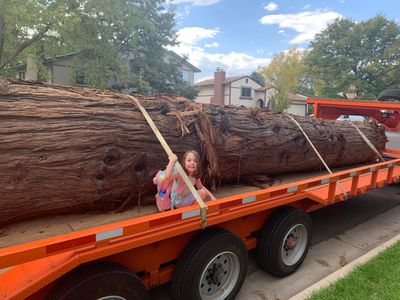
Massive caostal sequoia